Advanced Digital Marketing: Funnels, Analytics, and AI Implementation in 2026
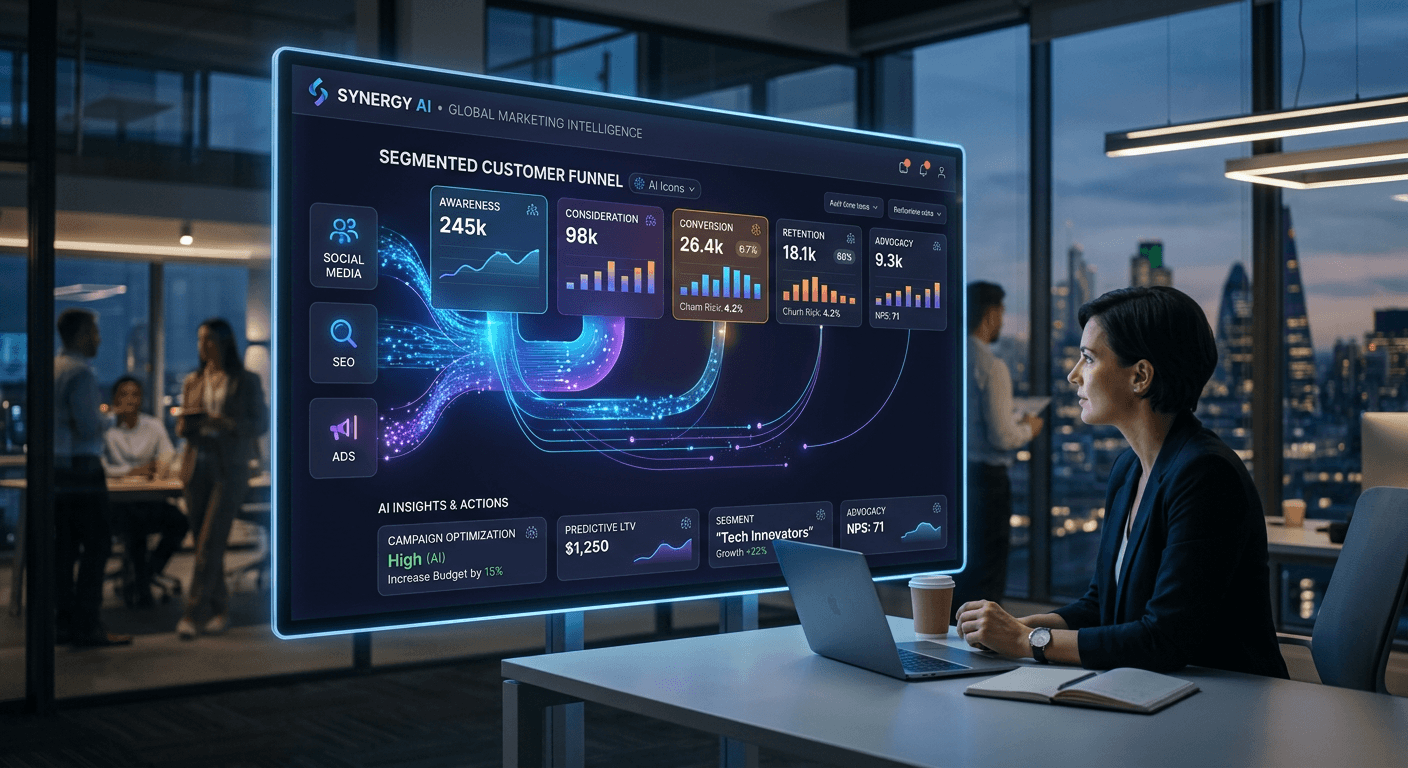
Modern digital marketing strategies have shifted from simple lead generation tactics to complex, data-driven ecosystems that prioritise hyper-personalisation. To remain competitive in 2026, organisations must bridge the gap between their technical infrastructure and consumer psychology, ensuring that every touchpoint within the digital marketing funnel is informed by real-time data and automated intelligence.
Quick Summary {#quick-summary}
Advanced digital marketing in 2026 integrates predictive analytics and generative AI to create seamless customer journeys. By leveraging granular data, marketers can automate content delivery and refine targeting to improve conversion rates and customer lifetime value across omnichannel environments.
- Implementing AI-driven predictive modelling for lead scoring.
- Optimising multi-touch attribution via advanced digital marketing and analytics stacks.
- Scaling personalised messaging through precise audience segmentation.
- Orchestrating cross-channel consistency across diverse digital marketing channels.
Table of Contents {#table-of-contents}
- Refining the Digital Marketing Funnel
- Leveraging Digital Marketing and Analytics
- The Impact of AI in Digital Marketing
- Advanced Audience Segmentation Techniques
- Integrating Digital Marketing Channels
- Future-Proofing Digital Marketing Strategies
- Frequently Asked Questions
- Recommended Reads

Refining the Digital Marketing Funnel {#refining-the-digital-marketing-funnel}
The traditional linear funnel has become obsolete, replaced by a non-linear, recursive customer journey. In 2026, the digital marketing funnel focuses on retention and advocacy as much as acquisition. By mapping the user journey through high-intent interaction points, marketers can identify friction in real-time, allowing for immediate interventions that prevent drop-offs.
Companies that successfully navigate this shift treat every stage of the funnel as an opportunity to provide value rather than just capturing data. This requires a shift from vanity metrics to outcome-based metrics, such as customer acquisition cost (CAC) versus lifetime value (LTV). You can find more resources on optimising these workflows at https://heylink.uk.com to better align your output with commercial goals.
Leveraging Digital Marketing and Analytics {#leveraging-digital-marketing-and-analytics}
Data-driven decision making now relies on sophisticated digital marketing and analytics stacks that go beyond basic dashboard reporting. Predictive analytics allow teams to forecast trends before they fully manifest, providing a distinct edge in market positioning. Modern tools now integrate machine learning to interpret complex datasets, offering actionable insights rather than raw logs.
Effective analytics involve establishing a 'single source of truth' for customer data, which includes consolidating offline and online signals. When these data points are unified, it becomes possible to create a complete picture of customer behaviour, enabling more accurate forecasting and more efficient budget allocation across the entire marketing mix.
The Impact of AI in Digital Marketing {#the-impact-of-ai-in-digital-marketing}
Generative and analytical ai in digital marketing has revolutionised content production and campaign management. AI models now handle tasks such as automated copywriting, dynamic creative testing, and real-time bid adjustments. This automation allows human marketers to focus on strategy and creative direction rather than repetitive execution.
Pro Tip: Do not view AI as a replacement for human oversight; instead, use it to handle data-heavy tasks such as pattern recognition in high-volume traffic, allowing your team to focus on the nuanced storytelling that AI currently struggles to replicate.
AI also enables hyper-personalisation at scale. By dynamically adjusting website content or email subjects based on user history, businesses can deliver unique experiences that feel tailor-made. The speed at which these adjustments occur ensures that the message is always relevant to the current state of the prospect.
Advanced Audience Segmentation Techniques {#advanced-audience-segmentation-techniques}
Sophisticated audience segmentation in 2026 is no longer restricted to demographics or basic geographic location. Behavioural, psychographic, and intent-based segments allow for a depth of targeting that minimises wasted ad spend. By clustering users based on their likelihood to convert and their specific interests, brands can create bespoke messaging that resonates deeply with small, highly relevant cohorts.
Modern segmentation strategies often involve cohort analysis to track how user groups evolve over time. If a specific cluster shows high engagement but low conversion, AI can suggest triggers, such as personalised discounts or educational content, to move them along the conversion path. This level of granular control is essential for maintaining high engagement levels in competitive markets.
Integrating Digital Marketing Channels {#integrating-digital-marketing-channels}
Optimising digital marketing channels requires a cross-channel orchestration strategy that ensures the brand voice and offer remain consistent across social, search, email, and organic discovery. Omnichannel marketing is the standard; users expect to switch devices and platforms without losing the context of their interaction with a brand.
| Channel Type | Primary Focus | Best Practice |
|---|---|---|
| Paid Social | Awareness & Retargeting | Dynamic Creative Optimisation |
| Search (SEO/SEM) | High-Intent Capture | Semantic Search Alignment |
| Email/CRM | Retention & Lifetime Value | Predictive Personalisation |
| Content Marketing | Authority Building | Interactive Data Narratives |
Future-Proofing Digital Marketing Strategies {#future-proofing-digital-marketing-strategies}
Resilient digital marketing strategies are those that prioritise agility and privacy-first data collection. With shifting regulatory landscapes, brands must build first-party data assets that are not dependent on third-party tracking. This shift encourages deeper relationships with customers, as data is provided in exchange for tangible value, such as exclusive content or superior service.
Investing in sustainable growth means focusing on the intersection of brand equity and technical performance. Building a robust digital footprint can be expedited by leveraging expertise found at https://heylink.uk.com to ensure your technical implementation supports long-term strategic goals. Ultimately, those who balance technical precision with authentic brand identity will remain the market leaders.
Frequently Asked Questions {#frequently-asked-questions}
How has the digital marketing funnel changed in 2026?
The funnel has moved from a linear path to a continuous loop focused on retention and advocacy, driven by real-time data rather than broad awareness tactics.
Why is AI integration essential for modern marketing?
AI enables scale in personalisation and data processing, allowing brands to respond to customer needs in real-time, which is impossible with manual processes.
What are the most effective ways to use audience segmentation?
Use intent-based data and behavioural patterns rather than static demographic data to group users by their current stage of the journey and specific pain points.
How do I maintain privacy while using advanced analytics?
Prioritise first-party data collection and transparent value exchanges, ensuring all data handling aligns with current privacy regulations and user consent preferences.