Online Business Ideas: A Step-by-Step Guide for UK Startups in 2026
A small business owner rarely decides to "go digital" on a quiet Tuesday; the decision usually hits when the third wholesale client in a row asks for an online ordering link that does not exist. The pressure is no longer just about reaching new customers; it is about remaining visible to the ones you already have.
Quick Summary
Starting a digital business in 2026 means building a system that captures traffic, converts interest, and delivers value without requiring your physical presence for every transaction. It requires moving past a basic social media profile to own your customer data and sales process.
- Consolidate traffic: Direct all platform audiences to a single, owned landing page.
- Map the model: Use a social business model canvas to understand value exchange before spending money.
- Start lean: Test online business ideas with low-overhead digital products or services first.
- Own the data: Rely on first-party analytics rather than borrowed social media metrics.
Table of Contents
- 1. Validate What Is Digital Business for Your Niche
- 2. Draft Your Social Business Model Canvas
- 3. Select the Best Online Business Model for Your Skills
- 4. Build Your Central Landing Hub
- 5. Set Up Your Analytics and Pixels
- Common Pitfalls & Troubleshooting
- FAQ
- Recommended Reads
1. Validate What Is Digital Business for Your Niche
The first step is defining what a digital business actually means for your specific skill set. It is not merely putting a physical catalogue on a website. It is restructuring how value is delivered. If you are a consultant, it might mean transitioning from hourly calls to selling access to a structured community or a digital download. If you sell physical goods, it involves streamlining fulfillment and customer acquisition through digital channels.
The mechanics involve auditing your current (or planned) offerings and determining which elements require synchronous effort (you being there) versus asynchronous effort (a customer buying a pre-made asset). The goal is to maximize the latter.
The mistake people make here is trying to digitize a broken physical process. If your in-person booking system is chaotic, moving it online without simplifying the steps will just result in abandoned carts. They assume software fixes strategy.
Practical rule: Only digitize a transaction once you can map the entire customer journey on a single piece of paper, from discovery to fulfillment.
2. Draft Your Social Business Model Canvas
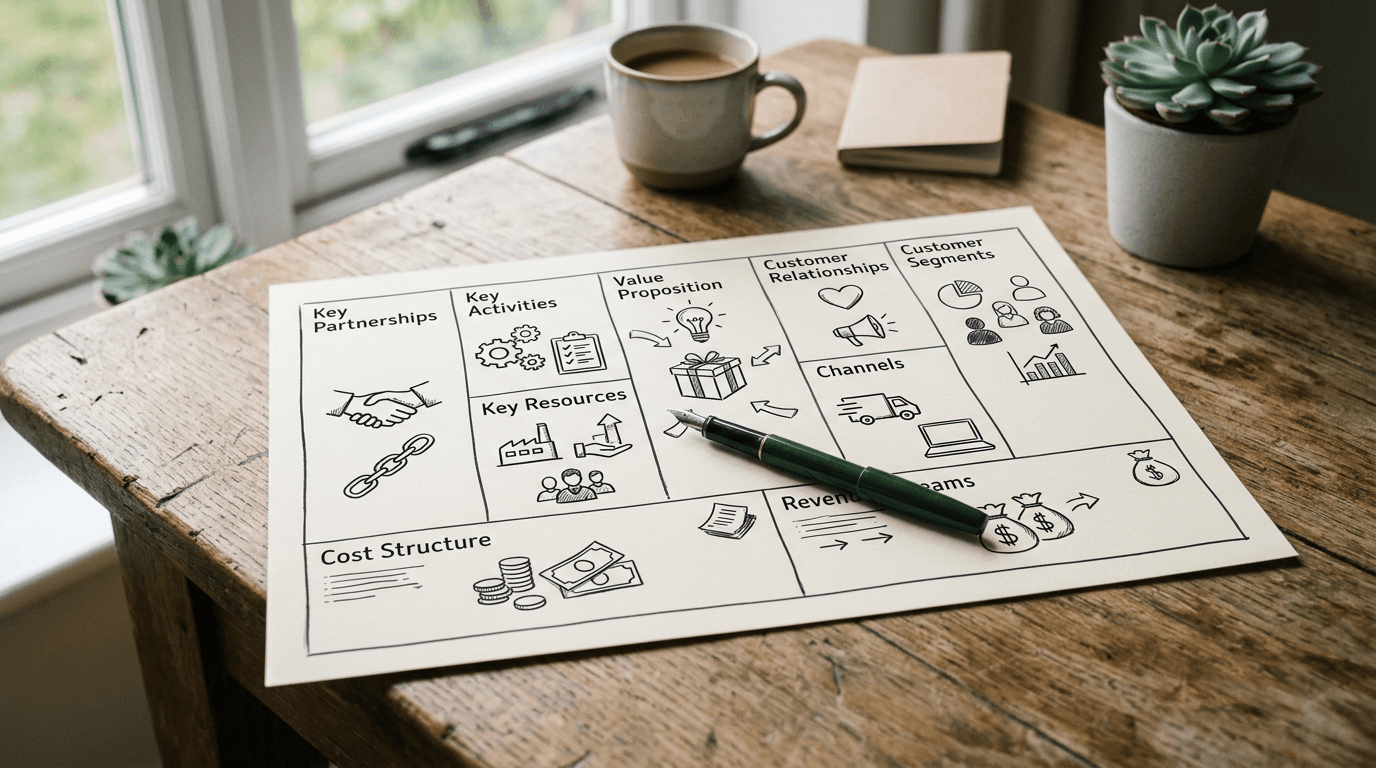
Before registering a domain or building a product, you must map out how the business will operate. The social business model canvas is a specific framework that forces you to define your value proposition, target audience, revenue streams, and key partnerships on a single page, with an emphasis on social impact or community engagement, which is vital for modern creators.

Mechanically, you fill out the nine blocks of the canvas. Start with the 'Customer Segments' and 'Value Propositions'. If you cannot clearly state why a UK freelancer needs your specific digital template, the rest of the canvas will not hold up. You then define your 'Channels' - how will these freelancers find you?
The common error in this step is treating the canvas as a static document rather than a working hypothesis. Founders write down "Instagram Ads" under channels without having tested the cost of acquisition. They build the business around an untested assumption.
3. Select the Best Online Business Model for Your Skills
Choosing the best online business model requires matching your capital, time, and expertise to market demand. The landscape is broad: e-commerce, digital products (courses, templates), service-based consulting, or affiliate marketing.
To execute this, evaluate your constraints. E-commerce requires capital for inventory and logistics unless you are dropshipping (which carries its own quality control risks). Digital products require high upfront time investment but offer nearly 100% margins later. Service businesses are fast to start but hard to scale without hiring.
The trap here is chasing the model with the lowest barrier to entry rather than the one that fits your expertise. A graphic designer might try dropshipping fitness gear because a tutorial made it look easy, ignoring their massive advantage in selling design templates or brand audits.
4. Build Your Central Landing Hub
You need a single destination to send your audience. Relying solely on a social media feed is dangerous because you do not own the algorithm or the audience data. A central hub, often a "link in bio" page or a streamlined landing page, acts as the definitive directory for your business.
This involves setting up a branded page that aggregates your key links: your shop, your booking calendar, your newsletter signup, and your digital business card. You must configure custom domains to maintain professional branding and arrange the links based on priority (e.g., your primary revenue driver goes at the top).
The failure mode in this step is link clutter. Founders treat their landing page like a junk drawer, listing 25 different links, previous campaigns, and outdated social profiles. When presented with too many options, a visitor clicks nothing.
5. Set Up Your Analytics and Pixels
A digital business runs blind without data. You must know where your traffic is coming from, what they are clicking, and where they are dropping off. This requires integrating analytics directly into your landing hub and storefront.
The mechanics require generating tracking pixels (like a Meta Pixel or Google Analytics tag) from your advertising or analytics platforms and pasting those codes into the settings of your landing page or website. This allows the platforms to communicate; when someone clicks your link on TikTok and buys on your page, the pixel records the journey.
The mistake founders make is installing the pixel after they launch their first campaign, missing the initial wave of data. They spend money driving traffic but have no way to retarget the visitors who did not buy on the first visit, wasting their acquisition budget.
Common Pitfalls & Troubleshooting
High Traffic, Zero Conversions
If your dashboard shows hundreds of visitors but no sales, the issue is rarely the product itself; it is the friction in the buying process or a mismatch in expectations.
- The Fix: Review your landing page. Ensure the value proposition is clear within three seconds and that the checkout requires no more than three clicks.
Inconsistent Revenue Months
Experiencing a massive sales spike followed by weeks of silence usually indicates a reliance on a single, volatile traffic source, like a viral social media post.
- The Fix: Build an email or SMS list. Use your central landing hub to offer a small, free digital product in exchange for contact information, allowing you to market to them directly, independent of algorithms.
Overwhelming Admin and Support
If you are spending more time answering basic customer questions than building the business, your systems are failing.
- The Fix: Audit the questions. If the same question is asked three times, the answer belongs on your landing page or in an automated FAQ sequence in your customer onboarding.
FAQ
Do I need to register as a business immediately?
In the UK, you can operate as a sole trader initially, but you must register with HMRC for Self Assessment once your trading income exceeds £1,000 in a tax year.
How much does it cost to start?
It depends on the model. A digital product or service business can start with minimal overhead (often just the cost of a domain and a low-cost landing page platform), while physical e-commerce requires inventory capital.
Why is an email list better than social followers?
You own your email list. Social platforms can change their algorithms or ban accounts without notice, cutting off your access to the audience you built there.
Can I run a digital business entirely from my phone?
While content creation and basic communication can be done on a phone, serious platform configuration, writing a business model canvas, and deep analytics review realistically require a desktop environment.